
Almost everyone has experienced it at least once. The seatbelt sign turns on, the plane starts shaking, and suddenly you wonder how safe flying really is.
Turbulence can feel dramatic. But when you look at actual plane crash statistics, the picture becomes much clearer. Commercial aviation remains one of the safest ways to travel anywhere in the world.
Below is a simple breakdown of the numbers and what they actually mean for travelers.
How Rare Are Plane Crashes?
In both 2024 and 2025, commercial aviation maintained a very strong safety record around the world.
In 2024, there were 54 reported accidents involving commercial aircraft out of about 37.9 million flights worldwide. That works out to roughly one accident for every 702,000 flights.
Only seven of those accidents were fatal, which equals a fatal accident risk of about 0.06 per million flights.
In 2025, the numbers improved slightly overall. There were 51 accidents across 38.7 million flights, or about one accident for every 759,000 flights.
Fatal accidents did increase slightly, rising from seven in 2024 to eight in 2025. That pushed the fatality risk up to 0.17 per million flights. Even so, the increase was largely tied to a small number of major incidents.
To put the risk in perspective, a person is far more likely to be struck by lightning in their lifetime than to be involved in a fatal commercial aviation accident.
Commercial Jets vs Small Planes
When people hear about plane crashes, they often picture large passenger jets. In reality, most aviation accidents involve much smaller aircraft.
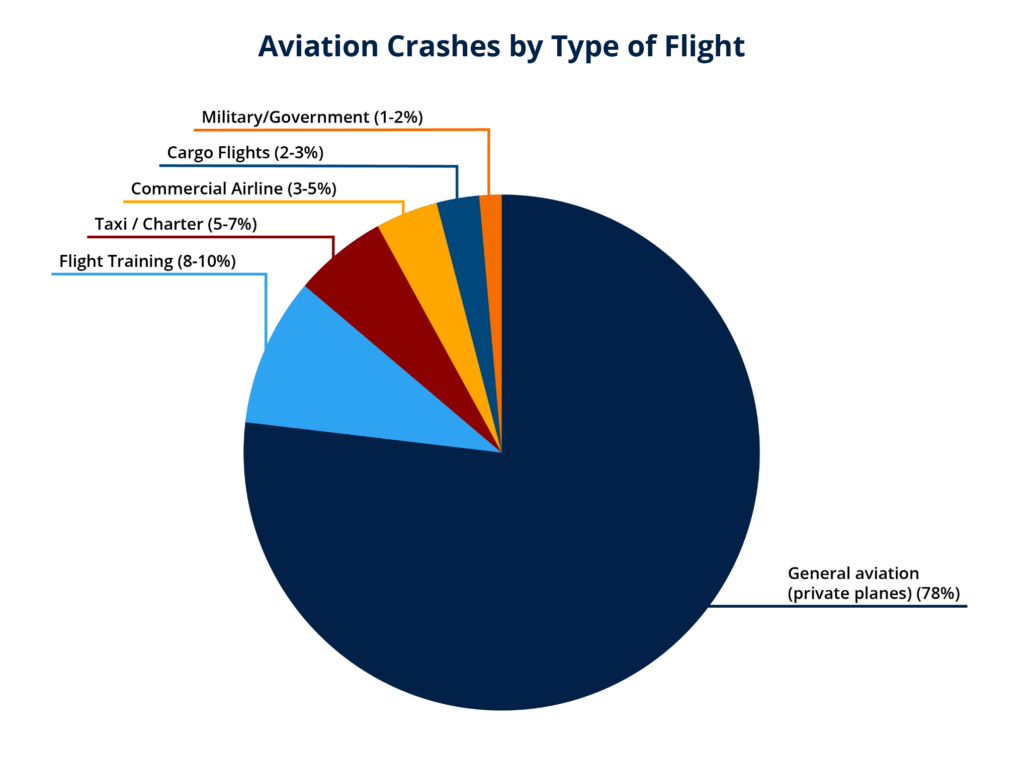
About 78% of aviation crashes happen in general aviation, which includes:
- Private planes
- Small charter aircraft
- Flight training planes
- Recreational flying
Large commercial airlines make up only a small percentage of total aviation accidents.
Commercial aircraft operate under strict federal safety rules. Airlines follow detailed maintenance schedules, pilots complete extensive training, and flights are constantly monitored by aviation authorities. These safeguards are a major reason why serious accidents involving passenger airlines are so rare.
Why Plane Crashes Still Happen
When aviation accidents do occur, they usually involve several factors rather than one single problem.
Investigations generally point to three main causes.
Human factors
Pilot decision making, fatigue, or communication errors contribute to roughly 80% of incidents.
Mechanical issues
Aircraft component failures or maintenance problems account for about 20% of cases.
Weather
Severe weather plays a role in about 10 to 11% of accidents, sometimes combined with other issues.
The most critical parts of any flight are takeoff and landing. Because of this, pilots spend a large amount of training time practicing procedures for these phases of flight.
Flying vs Driving: A Comparison Many Texans Understand
For many people in San Antonio, daily travel means dealing with traffic on I-10, Loop 410, or Highway 281.
When you compare the numbers, flying is significantly safer than driving.
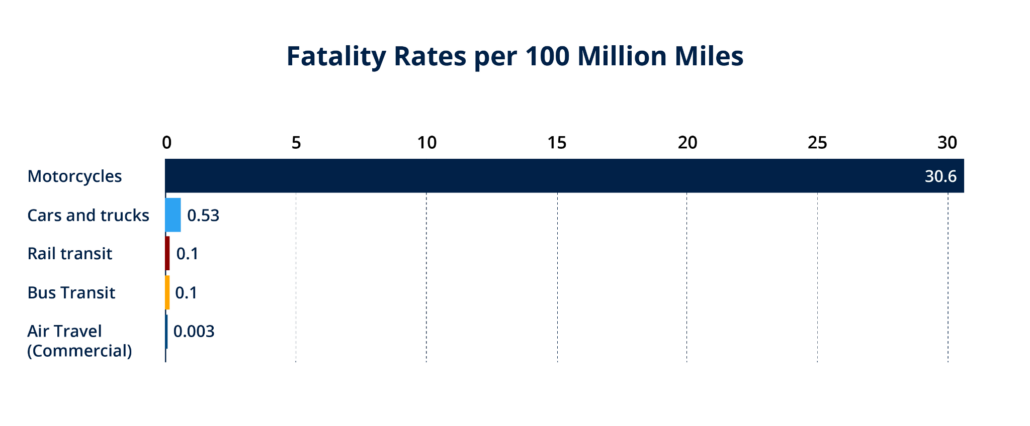
Per 100 million passenger miles traveled:
- Air travel: 0.004 injuries and 0.003 deaths
- Passenger vehicles: 42 injuries and 0.53 deaths
- Motorcycles: 399 injuries and 30.6 deaths
In simple terms, you are thousands of times safer flying than driving the same distance.
Even walking or riding a bus carries a higher risk per mile than flying on a commercial airline.
What These Statistics Actually Mean
Even people who fly frequently face very small risks.
Someone who flies across the country every week for decades still has an estimated lifetime fatal accident risk of only about 0.03%.
Looking at U.S. transportation deaths helps show the difference:
- Fewer than 100 people typically die in U.S. commercial aviation accidents in most years
- Around 40,000 people die in car crashes each year
Modern aviation safety depends on several layers of protection, including:
- FAA oversight and regulations
- extensive pilot training
- strict aircraft maintenance requirements
- constant safety improvements after investigations
These systems work together to keep air travel extremely safe.
What Happens If an Aviation Accident Does Occur?
Although aviation accidents are rare, they can still happen. When they do, the legal issues can become complicated very quickly.
Airlines and insurance companies often move fast after an accident. In some cases, early settlement offers may not fully reflect the true value of a claim.
Serious aviation injuries can involve:
- long term medical care
- permanent disabilities
- lost income
- emotional trauma
- wrongful death claims
Insurance companies are focused on limiting payouts. Without legal guidance, families may accept far less compensation than they are legally entitled to receive.
Legal Help for Aviation Injury Cases
A lawyer experienced in aviation accidents can help protect your rights by:
- preserving evidence from the crash investigation
- determining who may be legally responsible
- handling negotiations with insurance companies
- pursuing compensation for medical expenses, lost wages, and other damages
These cases can involve airlines, aircraft manufacturers, maintenance companies, or charter operators. Each situation requires a careful investigation.
Helping Injured Texans Move Forward
For more than 23 years, the Patrick Toscano Law Firm has helped injured Texans seek justice after serious accidents.
While the firm is widely known for handling cases involving car accidents, truck accidents, motorcycle crashes, bus accidents, and oilfield injuries, the same commitment applies to complex personal injury cases of all types.
The goal is simple. Make things right for clients and fight to recover every dollar they are entitled to.
If an aviation accident or serious travel injury affects you or your family, having an experienced legal team by your side can make the process easier to navigate.


